Bahr and Esseen Inequality
Published:
Bahr and Esseen (1965) Inequality provides a useful moment bound on the absolute sum of independent variable. It states as follows: let \(X_1,X_2,\ldots , X_n\) be a sequence of independent r.v.’s with \(EX_i=0\) and \(E|X_i|<\infty,1\leq i\leq n.\) If \(r\) satisfies \(\begin{aligned} D(r)=\frac{13.52}{(2.6 \pi)^r}\Gamma(r)\sin (r\pi/2)<1 \text{ and } 1\leq r \leq 2, \end{aligned}\) then \(E|\sum^n_{i=1}X_i|^r\leq \frac{1}{1-D(r)}\sum^n_{i=1}|X_i|^r.\)
Below is a plot of \(D(r)\). 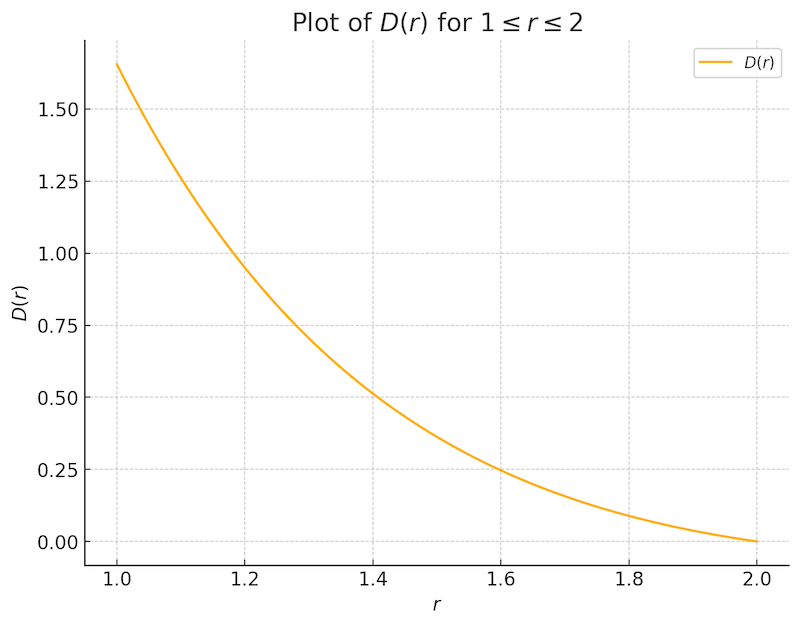
Reference
Von Bahr, B. E. N. G. T., and Carl-Gustav Esseen. “Inequalities for the rth absolute moment of a sum of random variables, \(1\leq r\leq 2\).” The Annals of Mathematical Statistics (1965): 299-303.